
Solar Panel Inspection & Thermal Imaging in San Clemente, CA
Find out if a production drop is dirt or a defective module, before you pay for a repair you might not need or miss one covered under warranty.
Pre & post-clean thermal scan · Warranty documentation · Available as an add-on
Not Every Production Drop Is a Dirty Panel
A gradual, even dip in production across your whole system usually points to soiling, salt film, or dust, the kind of thing a cleaning fixes. But a sudden drop, or underperformance isolated to a specific panel or section, is more likely a hardware issue: a failing bypass diode, a bad connection, or a defective module. Cleaning alone will not fix that, and you could pay for repeated cleanings without ever solving the actual problem.
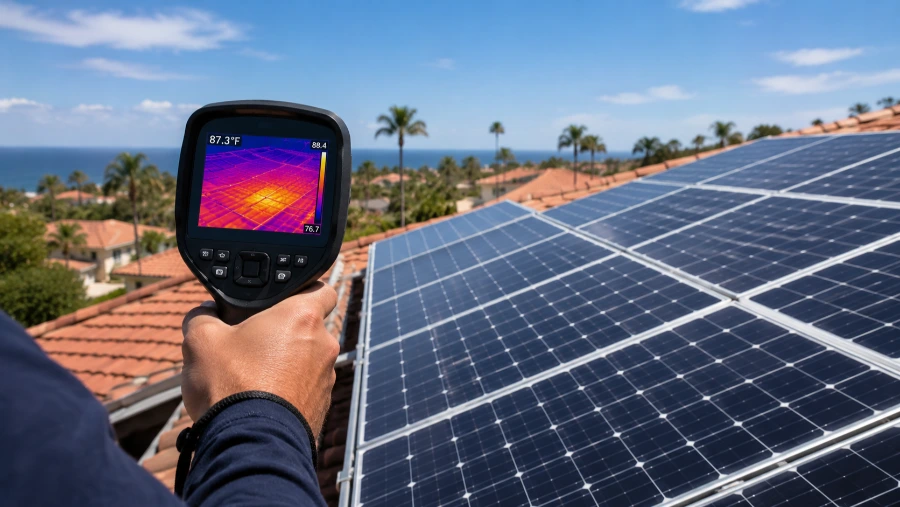
A thermal imaging scan shows the difference in minutes. Hotspots on a thermal camera reveal exactly where a panel is underperforming and why, before we ever put water on the array.
How the Inspection Works
- Thermal scan before cleaning. We photograph the array with a thermal imaging camera to identify any hotspots, which show up as areas running hotter than the surrounding cells.
- Cross-check against soiling. Soiling-related hotspots typically clear up after cleaning. Hardware-related hotspots do not, which is how we tell the two apart.
- Post-clean re-scan. A second thermal pass after cleaning confirms whether the hotspot resolved or is still present.
- Written report with photos. If a hotspot remains after cleaning, you get a dated thermal photo and a plain-language summary you can send directly to your solar installer, since defective modules are often still covered under a manufacturer’s parts-and-labor warranty.
Inspection & Thermal Imaging FAQ
Is thermal imaging included with every cleaning?
It is available as an add-on for any cleaning and is especially worth requesting if you have noticed an unexplained production drop or a specific panel underperforming compared to the rest of the array.
Can a defective panel really be covered under warranty?
Often, yes. Most residential solar installations carry a manufacturer parts-and-labor warranty, commonly around 10 years, that covers module defects. A dated thermal report gives your installer the documentation needed to file a warranty claim.
Do you repair the panels yourselves?
No. We identify and document the issue and provide the report to send to your original installer or a licensed solar contractor, since repairs and module replacement fall outside cleaning-only work.
Ask About a Thermal Scan
Call +1 (619) 332-4312 and mention your production concern when you schedule.